Home › Timeline › The Rail You Are On › Magnetometry at Uruk; the Book of Giants
Magnetometry at Uruk in 2001 and 2002 detects brick structures in the former bed of the Euphrates, west of the New Year temple, where the epic says Gilgamesh was buried; announced in April 2003, five weeks into the invasion; never excavated. And the Qumran Book of Giants, 4Q530–532, names Gilgamesh and Hobabish among the giants of Genesis 6.
In plain words
In 2001 and 2002 a magnetic survey at Uruk finds brick structures in the old bed of the Euphrates, where the epic says Gilgamesh was buried, and it is never excavated; the Qumran Book of Giants names Gilgamesh among the giants of Genesis 6. The structure is real and unopened. Identifying it as his tomb is open, and the surveyor calls it speculative.
The mechanism
THE JAR NAMES THE KING WHOSE GRAVE THE MAGNETOMETER FOUND — the 1947 cache that dated Isaiah also filed Gilgamesh, two-thirds god by the epic's own line, under Genesis 6:4. The surveyor himself calls the burial identification speculative; the structure is real and unopened
How it was checked
- EvidenceT6 PHYSICAL / MANUSCRIPT; Status: COMMITTED — detection; identification OPEN; a release
- Letter eraTHE RAIL YOU ARE ON 2001 to 2026
- Plate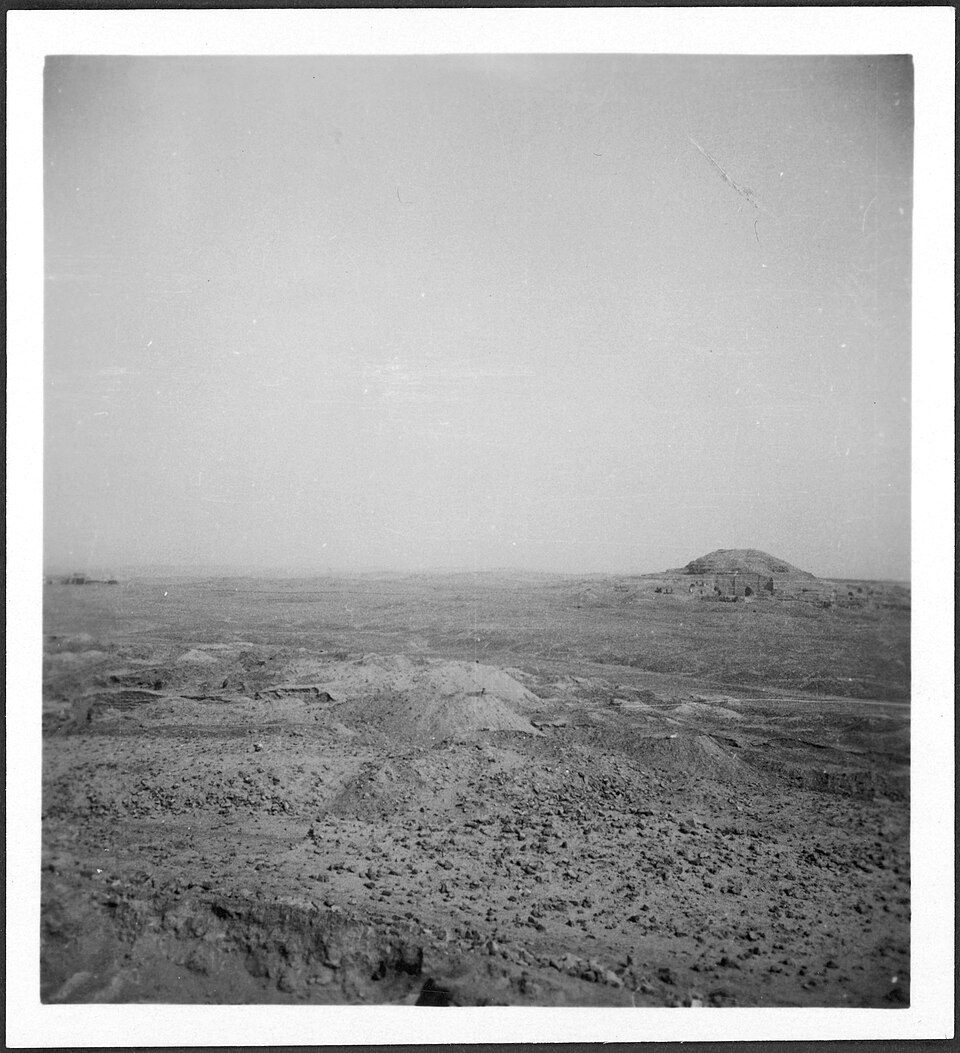 — Annemarie Schwarzenbach, the ziggurat at Uruk (Warka), Iraq, 1933-34 · Swiss National Library · Public domain · source: https://commons.wikimedia.org/wiki/File:CH-NB_-_Irak,_Uruk_(Warka)-_Zikurrat_-_Annemarie_Schwarzenbach_-_SLA-Schwarzenbach-A-5-03-131.jpg
- SourcesMANUSCRIPT — 4Q530; SECULAR RECORD — Fassbinder, Magnetometry at Uruk (2003), the Munich survey
The whole timelineThe Rail You Are OnThe historical recordAll eras